



Most people look at betting odds and see only potential profit. Experienced bettors see something else first: probability.
Odds are not random numbers. They are mathematical estimates of how likely an outcome is to happen. Once you understand how to convert odds into probability, betting becomes much clearer. You stop guessing emotionally and start reading the logic behind the market.
And surprisingly, the math itself is not complicated.
What Betting Odds Actually Represent
Every betting odd contains two things at the same time:
- Possible payout
- Implied probability
The higher the odds, the lower the expected probability of success.
Simple Rule
- Low odds = outcome considered more likely
- High odds = outcome considered less likely
Bookmakers build these numbers based on statistics, market movement, injuries, public opinion, and many other factors.
The Basic Formula For Decimal Odds
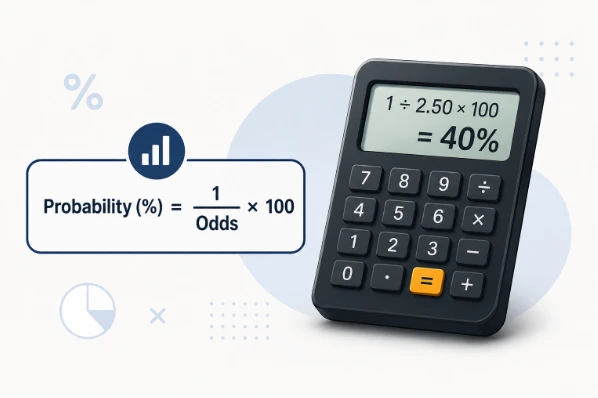
The simplest way to calculate implied probability from decimal odds is:
Probability=1Odds×100Probability=Odds1×100
This converts decimal odds into percentage probability.
Example 1: Favorite Team
If odds are:
Odds=2.00Odds=2.00
Then:
12.00×100=50%2.001×100=50%
This means the bookmaker estimates a 50% chance of winning.
Another Example With Higher Odds
Now imagine a weaker team with odds of:
Odds=4.00Odds=4.00
The calculation becomes:
14.00×100=25%4.001×100=25%
So the implied probability is 25%.
What This Tells You
The bookmaker believes this outcome is less likely — but not impossible.
That distinction matters a lot.
Why Probability Is More Important Than Odds
Many beginners chase high payouts without thinking about actual probability.
That usually leads to emotional betting instead of logical betting.
Smart Bettors Ask
- Is the probability realistic?
- Does the market overvalue a team?
- Is there hidden value in the odds?
Example Of Value Thinking
If you personally believe a team has a 60% chance to win, but the bookmaker odds imply only 50%, there may be betting value there.
The goal is not simply finding winners.
It is finding situations where probability and odds do not fully match.
Understanding Bookmaker Margin
Bookmakers do not create perfectly neutral odds. They include a margin to guarantee profit over time.
Example
Suppose two teams both have odds implying:
- 52% probability
- 52% probability
Together that equals 104%, not 100%.
The extra percentage is the bookmaker’s edge.
Fact: bookmaker margin (also called “vig” or “overround”) is built into nearly every betting market.
Why This Matters In Real Betting
Probability helps bettors avoid emotional decisions.
Without Probability Thinking
People often:
- Bet only on favorites
- Chase large payouts blindly
- Ignore long-term math
With Probability Thinking
Players begin to:
- Compare true value
- Understand risk better
- Think long-term instead of session-to-session
This applies not only to sports. Even people who play online casino games eventually encounter the same core idea: probability controls everything behind the scenes.
Common Mistakes Beginners Make
Learning the formula is easy. Using it correctly takes more discipline.
Frequent Errors
Many beginners understand the formula but misuse probability emotionally instead of mathematically.
Mistaking Probability For Certainty
Even if the chance of success is 70%, the chance of failure is still 30%. The high probability does not mean a result will occur. Favs can lose for so many reasons: injury, a mistake, simple randomness.
Ignoring Bookmaker Margin
The total implied probability will be greater than 100 percent in the bookmakers, as they built an edge in the odds. If this is not done, wagers can appear to be more meaningful than they actually are.
Overreacting To Recent Results
Too many players would rather see what has occurred over the past few games than the longer trends. A strong team doesn’t necessarily enjoy a string of victories.
Probability is a way of measuring risk, but not eliminating it entirely.
Simple Probability Cheat Sheet
Quick Examples
- Odds 2.00 → 50% probability
- Odds 1.50 → 66.7% probability
- Odds 5.00 → 20% probability
The pattern becomes intuitive over time.
Final Thoughts
Betting feels emotional on the surface, but underneath it is deeply mathematical.
Once you understand how odds translate into probability, the entire system starts looking different.
You stop seeing “good payouts.” You start seeing percentages, value, and risk. And that small shift in perspective is where smarter betting usually begins.