



If you follow European soccer, you probably know that rivalries can get a little… heated. That was definitely the case in the recent UEFA Champions League qualifying match between FC Copenhagen from Denmark and Malmö FF from Sweden.
These two clubs are no strangers to each other — they’re both top teams in Scandinavia, and whenever they meet, there’s
pride, history, and bragging rights on the line. But this time, it wasn’t just the players battling it out on the field. The coaches were going back and forth with words, too.
What Happened Before the Match?
The drama started before a ball was even kicked. Malmö’s coach, Henrik Rydström, had a press conference before the first game. Instead of just talking about tactics, he spent a lot of time mentioning that FC Copenhagen has a much bigger budget than Malmö.
Now, he wasn’t wrong — FC Copenhagen really does have a much higher budget. They’re one of the wealthiest clubs in Scandinavia. Their stadium, Parken, can hold more than 38,000 fans, and they’ve played in the group stages of the Champions League multiple times. Bigger budgets often mean better training facilities, higher player wages, and the ability to sign more expensive players.
For example:
The average player at a top Champions League club can make several million dollars a year.
FC Copenhagen has invested heavily in buying experienced international players from countries like Portugal, Spain, and the Netherlands.
Malmö FF, while still a strong club, usually spends less and focuses more on developing talent from Sweden.
Rydström’s comments sounded a little like he was preparing excuses in advance. He kept pointing out how much more money FC Copenhagen had to spend and how that was a big advantage.
The First Leg: Malmö’s Chance
The first leg of the tie was played in Malmö, and the Swedish fans were ready for a fight. Malmö is no pushover — they’ve played in the Champions League group stage themselves, famously beating big clubs like Shakhtar Donetsk in past years.
But this time, things didn’t go well for them. FC Copenhagen’s defense was rock-solid, and their attack looked dangerous every time they moved forward. Even though Malmö fought hard, they couldn’t break through. By the time the whistle blew, FC Copenhagen had the upper hand.
The Second Leg: FC Copenhagen Dominates
If Malmö had hoped for a miracle in the second leg in FC Copenhagen’s Parken Stadium, they were in for a tough night. In front of their home fans, FC Copenhagen showed exactly why they’re one of the top clubs in northern Europe.
The final score over the two games? 5-0 on aggregate. That means that over the two legs combined, Malmö didn’t score a single goal, while FC Copenhagen scored five. In soccer, that’s not just a win — that’s a statement.
Neestrup’s Response
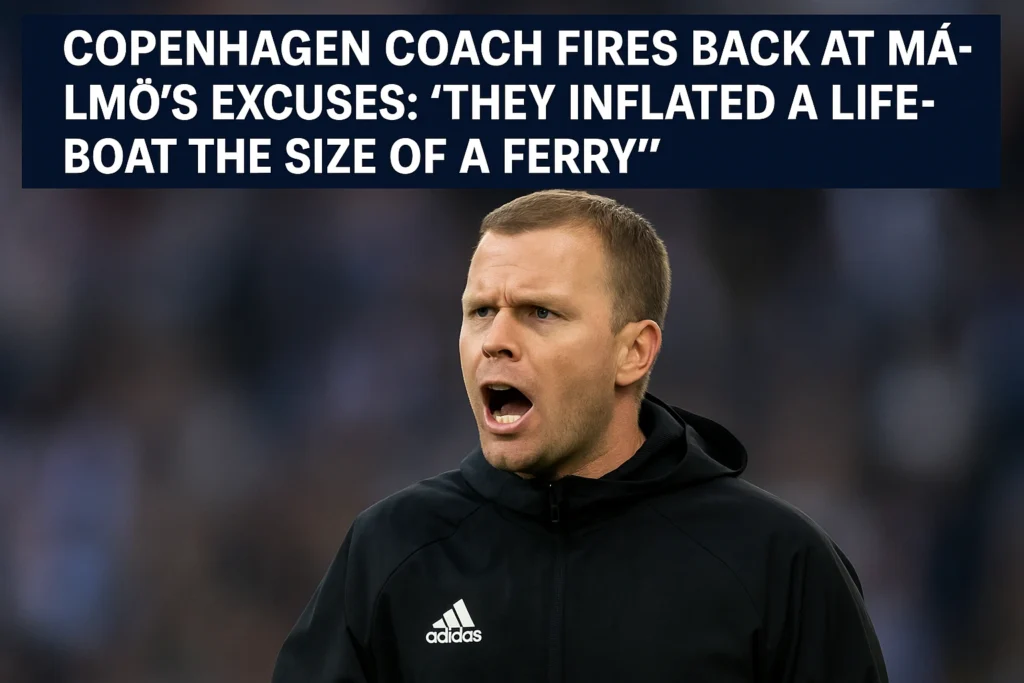
After the second leg, Copenhagen’s head coach Jacob Neestrup didn’t hold back when reporters asked him about Rydström’s pre-match comments.
“I must admit,” Neestrup said, “that when the opposing coach and players start talking about budget differences, the coach’s salary, and the players’ salaries, then I know we have won.”
In other words, if the other team is already talking about how much richer you are before the game starts, it’s probably a sign they don’t believe they can win on the field.
Neestrup added, “We have earned and worked hard for every penny of the money we have spent on class players, and that showed the class difference today.”
And then came the most colorful part of his statement. Neestrup compared Malmö’s talk about money to “inflating a lifeboat the size of a ferry.”
That’s a funny image — a lifeboat is supposed to be small, just enough to keep you safe in an emergency. But if you try to make it as big as a ferry (which is massive), it’s ridiculous. What he meant was that Malmö tried to make their financial disadvantage into a huge excuse, bigger than it really needed to be.
The Budget Debate in Soccer
This exchange highlights a real topic in soccer — how much money a club has can make a big difference.
Clubs with big budgets can buy top players, hire world-class coaches, and build amazing facilities.
Clubs with smaller budgets often focus on scouting and developing young talent.
It’s not always the richer club that wins — history is full of underdog stories. For example, Leicester City famously won the English Premier League in 2016 despite having a much smaller budget than giants like Manchester City or Chelsea. But in the long run, money often plays a big role in consistent success.
In European competitions like the Champions League, budget differences can be massive. Clubs like Real Madrid and Manchester City spend hundreds of millions on their squads, while smaller clubs from smaller leagues sometimes spend less than one star player’s salary.
Why FC Copenhagen Won
Looking at the games, it wasn’t just about money — it was also about performance:
Tactical discipline:FC Copenhagen kept their defensive shape and didn’t give Malmö many chances.
Clinical finishing: When FC Copenhagen had opportunities to score, they took them.
Experience: Many FC Copenhagen players have played in big European games before, so they didn’t get nervous under pressure.
Soccer fact: FC Copenhagen has reached the Champions League group stage several times in the past decade, while Malmö’s appearances have been less frequent. That kind of experience often gives a team extra confidence.
The Rivalry Factor
Matches between Danish and Swedish teams are about more than just soccer. They’re also about national pride. Denmark and Sweden have a long history of sporting rivalries, from handball to ice hockey. When clubs from these countries face off, fans see it as more than just a normal game — it’s bragging rights for an entire nation.
After FC Copenhagen’s big win, Danish fans celebrated not just the victory, but also the fact that they had beaten one of Sweden’s best teams so convincingly. Malmö fans, on the other hand, were left frustrated, knowing they’d have to wait for another chance to get revenge.
The Takeaway
In the end, Neestrup’s comments made one thing clear: FC Copenhagen believed in their quality, and they showed it on the field. Malmö might have had a point about budget differences, but in soccer, talking before the game doesn’t count for much — it’s the 90 minutes on the pitch that decide everything.
The 5-0 result will go down as one of FC Copenhagen’s most dominant wins over a Scandinavian rival in recent memory. And for Malmö, it’s back to the drawing board.
Next time, maybe they’ll talk less about money and more about how they plan to score goals. Because as any soccer fan knows: goals, not budgets, win games.