



After 17 long years without winning any big trophy, Tottenham Hotspur finally broke their drought earlier this year. They had their chance to make it two major trophies in a row when they faced Paris Saint-Germain (PSG) in the UEFA Super Cup Final at the Bluenergy Stadium.
For anyone who might not know, the UEFA Super Cup is a special match played between the winners of the UEFA Champions League and the UEFA Europa League from the previous season. It’s basically a battle to see who is the “super champion” of Europe for that year.
New Coach, New Energy for Tottenham
Tottenham had a new man in charge — Thomas Frank — after Ange Postecoglou was surprisingly removed by club chairman Daniel Levy earlier in the summer. Frank didn’t waste time showing his style. In the first three minutes, Spurs had already taken two shots, even if both missed the target. They were playing brave, attacking soccer — the same approach Chelsea had used earlier in the year when they faced PSG in the FIFA Club World Cup Final.
PSG’s Usual Possession Game Meets Tottenham’s Tough Defense
PSG is famous for keeping the ball and controlling possession. In fact, in this match, they ended up with 74.1% possession, which is a huge amount — for reference, in soccer, anything over 60% is considered dominant.
But Tottenham weren’t scared. They defended with discipline, then tried long passes toward their striker Richarlison. This “direct style” caused problems for PSG because Richarlison could either shoot himself or pass the ball down to teammates with clever headers and knockdowns.
Tottenham Scores First
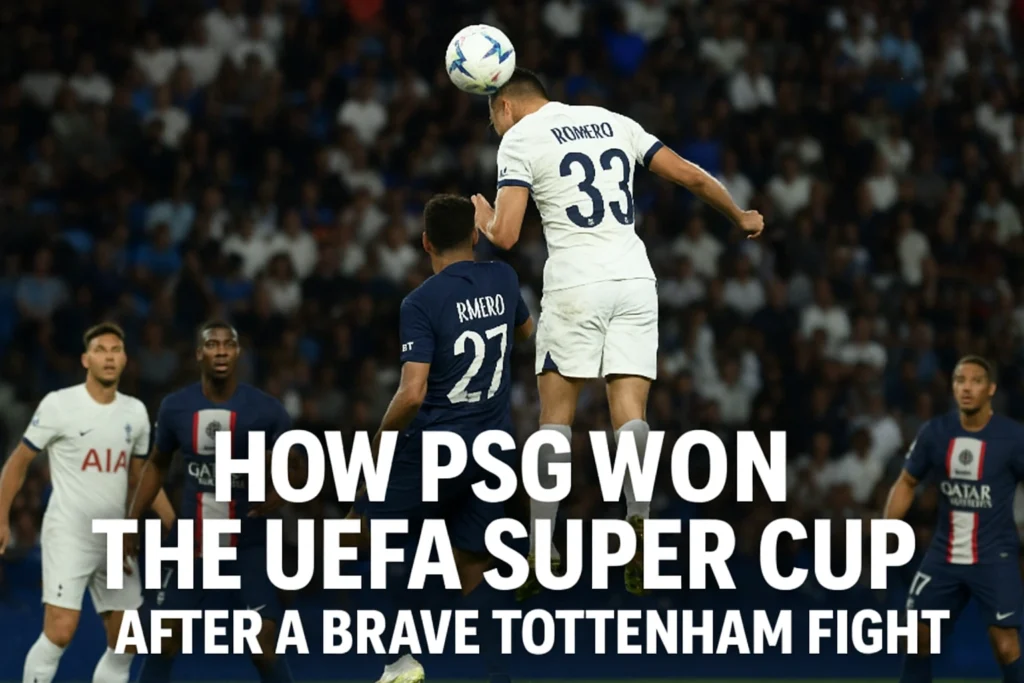
In the 38th minute, Tottenham’s plan paid off. A high ball was sent toward defender Cristian Romero. The Argentine defender won the aerial duel (that’s when two players jump for a high ball) and headed it into the danger area. PSG’s goalkeeper, Lucas Chevalier — making his debut — managed to block Joao Palhinha’s first attempt, but Dutch defender Micky van de Ven reacted quickly and smashed the ball into the net.
At that point, PSG had only managed three shots all game, and none had really tested Tottenham’s goalkeeper. Spurs’ goal was well deserved.
One of PSG’s most active players was Vitinha, who kept finding pockets of space in midfield. He was trying to pull Tottenham’s midfielders Pape Matar Sarr and Palhinha out of position, but Spurs were holding firm.
Second Half Shock — Tottenham Doubles Their Lead
The second half began, and just two minutes in, Tottenham stunned PSG again. Pedro Porro took a free kick and sent the ball into the box. Romero found himself completely unmarked at the back post and powered a header toward goal. Chevalier got his hands on it, but the ball slipped through and crossed the line.
It was now 2-0 to Spurs — and against the Champions League winners! This was becoming a real upset story. However, in soccer, a two-goal lead can be tricky. It’s comfortable, but one goal from the opponent can quickly change the momentum.
PSG’s Struggles and Key Substitutions
PSG had some of their stars struggling. Khvicha Kvaratskhelia, the Georgian winger who usually dazzles defenders, was having a quiet game. He only had 30 touches on the ball, which is low for an attacking player. He was substituted after an hour.
Then, Luis Enrique — PSG’s coach — made more changes. Over the next 15 minutes, fresh legs started to push Tottenham back into their own half.
Soccer fact: In knockout matches, especially finals, substitutions can be game-changers because tired defenders can struggle to keep up with fast, energetic players.
PSG Fight Back
Tottenham still had chances, but PSG began firing more shots. By the 84th minute, substitute Lee Kang-in curled in a beautiful strike from outside the penalty box to make it 2-1. Suddenly, the pressure was all on Spurs.
Tottenham’s full-backs, Porro and Djed Spence, started losing the ball more often. PSG kept sending in crosses — by the end of the match, they had attempted 25 crosses in total, which is a lot in a 90-minute game.
And then, with only two minutes of injury time left, PSG struck again. Achraf Hakimi slid the ball to Ousmane Dembele, who whipped in a perfect cross. Substitute Goncalo Ramos leapt highest and headed the ball into the net. Despite Tottenham having nine players inside the 12-yard box, no one could react in time. It was 2-2, and the game was heading to penalties.
The Drama of Penalty Kicks
Penalty shootouts are one of the most nerve-wracking ways to decide a soccer match. Each team takes turns shooting from the penalty spot, 12 yards from goal, with only the goalkeeper to beat.
Tottenham took the early advantage when PSG’s Vitinha missed, even though he had sent Tottenham goalkeeper Guglielmo Vicario the wrong way. But the pressure of the moment got to Spurs. Micky van de Ven and Mathys Tel both missed their kicks. That gave Nuno Mendes the chance to win it for PSG, and he calmly slotted his shot into the corner. PSG were Super Cup champions.
Lessons for Tottenham
Even though they lost, Tottenham’s performance gave fans hope. They showed that by playing a simpler, more direct style, they could trouble even one of the world’s best teams. They didn’t try to match PSG’s passing game — they stuck to their strengths.
Mohammed Kudus was one of Tottenham’s standouts. He created the most chances for his team (three), sent in the most crosses (four), and had the third-best passing accuracy (83.3%). Those numbers show he was a constant threat.
Soccer Fact Box:
UEFA Super Cup: A one-off match between the Champions League winner and Europa League winner.
Possession: A stat showing which team had the ball more. Spurs had only 25.9% here, but still almost won.
Crosses: When a player sends the ball from the sides of the pitch into the penalty area to create chances.
Aerial Duel: When two players jump to compete for a ball in the air. Spurs’ first goal came from winning one.
Penalty Shootout: Decides the winner if a match ends in a draw after normal time (and extra time if played).
Final Thoughts
History will record PSG as the winners, but Tottenham were more than a match for them for most of the game. They defended bravely, took their chances, and came within minutes of lifting the trophy.
In soccer, sometimes the better passing team wins. Sometimes the team with less of the ball but more determination comes out on top. This time, penalties made the difference. PSG’s experience showed when it mattered most, but Spurs left the field with pride — and a clear blueprint for the season ahead.