



FC Barcelona has once again raised concerns about refereeing decisions after their recent Champions League clash with Atlético Madrid. The Catalan club officially sent another complaint to UEFA, the organization that runs European competitions, saying that several key decisions during the two matches were unfair and may have affected the final result.
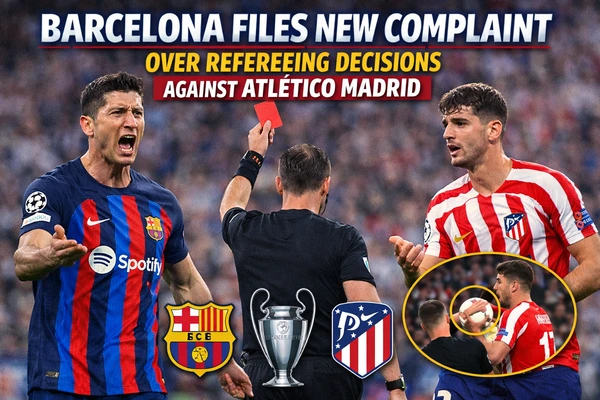
What happened in the matches?
Barcelona and Atlético Madrid faced each other in a Champions League quarter-final tie played over two legs (home and away games). Atlético Madrid won the tie 3-2 on aggregate, meaning they scored more total goals across both matches. The first match ended 2-0 in favor of Atlético, while Barcelona tried to fight back in the second game but fell short.
One important thing to note is that both matches were very intense and included multiple controversial moments. Barcelona ended both games with only 10 players on the field. First, young defender Pau Cubarsí was sent off in one match, and then Eric García received a red card in the other. Playing with one less player makes it much harder for any team to compete, especially at such a high level.
Why is Barcelona complaining?
Barcelona believes that the referees made several mistakes during the matches. Their main complaint is about a possible handball by Atlético defender Marc Pubill during the first leg. According to Barcelona, the ball hit the player’s hand in a situation where it could have been given as a penalty.
In football (soccer), a handball happens when a player touches the ball with their hand or arm in a way that is considered illegal. If this happens inside the penalty area, the opposing team may be awarded a penalty kick. Penalty kicks are very important because they have a high chance of resulting in a goal.
Barcelona also mentioned that there were two other situations where they believed they should have been awarded penalties, but the VAR system did not intervene.
What is VAR and why is it important?
VAR stands for Video Assistant Referee. It is a system used in modern football to help referees make better decisions by reviewing video footage. VAR is usually used in important situations like goals, penalties, red cards, and mistaken identity.
Barcelona argued that VAR should have stepped in during these key moments but failed to do so. They said this lack of intervention played a big role in how the matches turned out.
UEFA’s response
Earlier this week, UEFA rejected Barcelona’s first complaint and called it “inadmissible.” This means they did not accept it as a valid case to review. Despite this, Barcelona decided to submit another complaint, showing how strongly they feel about the situation.
The club said that the refereeing decisions “did not comply with the Laws of the Game.” These laws are the official rules that all football matches must follow. Barcelona believes the rules were not applied correctly and that this led to an unfair outcome.
Impact on the team
Barcelona stated that these decisions had a direct impact on both matches and the final result. They also mentioned that the situation caused “sporting and financial harm” to the club.
Sporting harm refers to losing the chance to advance in the tournament, which is a big deal. The Champions League is one of the most prestigious competitions in football, and reaching the later stages can boost a team’s reputation.
Financial harm is also important. Clubs earn a lot of money from progressing in the Champions League through prize money, sponsorships, and ticket sales. Missing out on this can affect the club’s finances.
Interesting soccer facts related to this situation
- In football, red cards (like the ones received by Barcelona players) force teams to play with fewer players, which usually lowers their chances of winning.
- Penalty kicks have a success rate of around 75–80%, making them one of the best scoring opportunities in the game.
- The use of VAR has reduced clear refereeing mistakes, but it is still controversial because decisions can depend on interpretation.
- Matches with many attacking chances and controversial calls often end with over 2.5 goals, which means three or more goals are scored. In this case, the total score across both matches was 3-2, which fits into that category.
Barcelona’s message to UEFA
Despite their frustration, Barcelona said they are willing to work together with UEFA to improve the refereeing system. They want football to be more fair and transparent for all teams.
They emphasized that better use of VAR and stricter application of the rules could help prevent similar situations in the future. This shows that the club is not only focused on their own case but also on improving the game overall.
Soccer news context
Refereeing decisions have been a hot topic in football recently. Many teams across Europe have complained about inconsistent use of VAR and unclear decisions. Even top leagues like the Premier League and La Liga have faced criticism.
This situation involving Barcelona and Atlético Madrid is just one example of a bigger issue in modern football. As technology becomes more involved in the game, fans and teams expect fewer mistakes. However, human judgment is still part of the process, which means controversies can still happen.
Final thoughts
Barcelona’s complaint highlights how important refereeing decisions are in football. A single moment, like a missed handball or a red card, can change the outcome of an entire match—or even a whole tournament.
While Atlético Madrid celebrated their 3-2 aggregate win and moved on to the next round, Barcelona is left wondering what could have been if those decisions had gone differently.
At the end of the day, football is full of passion, drama, and sometimes controversy. Matches with high intensity, red cards, and multiple goal chances often lead to exciting outcomes, including games with over 2.5 goals—just like this one.
If UEFA responds again or makes changes to how VAR is used, this situation could have a lasting impact on future matches in the Champions League.