



The 2025–26 European soccer season is already bringing drama — and Crystal Palace are right in the middle of it. The London-based club will not be playing in the UEFA Europa League this year, even though they originally qualified for it. Instead, they’ve been moved down to the UEFA Europa Conference League.
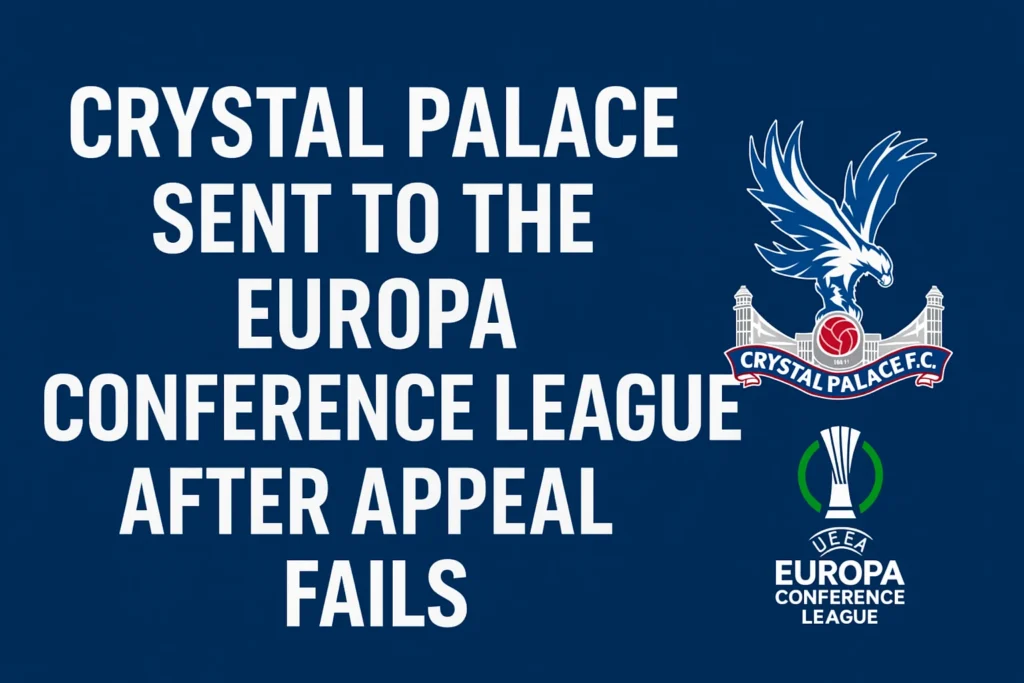
Why? Well, the decision comes after the Court of Arbitration for Sport (CAS) dismissed their appeal against UEFA’s ruling. This ruling was connected to the sport’s “multi-club ownership” rules — a set of regulations that many casual fans might not even know exists.
Let’s break down what happened, why it matters, and how it all connects to the larger world of European soccer.
How Crystal Palace Got Here
Crystal Palace earned a spot in the 2025–26 Europa League in an exciting way — by winning last season’s FA Cup. In the final, they faced one of the toughest opponents imaginable: Manchester City, one of the richest and most successful teams in the world. The FA Cup is one of the oldest and most famous knockout competitions in soccer, and winning it not only brings glory, but also a ticket to European competition the next season.
For Palace, winning the cup was a huge achievement. This is a club that hasn’t always been in the spotlight. They’ve spent many years fighting to stay in the Premier League, so lifting the FA Cup trophy was something their fans will remember for decades.
Normally, an FA Cup winner who isn’t already qualified for the UEFA Champions League gets a spot in the UEFA Europa League — the second-most prestigious European club tournament, right after the Champions League itself. So far, so good… until UEFA got involved.
What is the “Multi-Club Ownership” Rule?
UEFA — the Union of European Football Associations — is the organization that runs all major European club tournaments, like the Champions League, Europa League, and Europa Conference League. They also set rules to make sure competitions are fair.
One of these rules is about multi-club ownership. This means that if one person or company owns significant shares in more than one club, and those clubs qualify for the same UEFA competition, there’s a potential conflict of interest.
Think about it: if two clubs in the same competition have the same owner, what happens if they play each other? Even if everything is done honestly, people might suspect unfair influence. UEFA wants to avoid even the appearance of that problem.
The Problem for Crystal Palace
Crystal Palace’s situation centers around businessman John Textor. He’s a major investor in sports clubs around the world. Textor owns a significant stake in Crystal Palace, but he’s also the majority shareholder of Olympique Lyonnais (commonly known as Lyon), a famous club in France’s Ligue 1.
Here’s where the problem started: Lyon also qualified for the UEFA Europa League this season. That meant two clubs connected to the same main investor were going to play in the same tournament. Under UEFA’s multi-club ownership rules, this isn’t allowed.
UEFA’s solution was to move Crystal Palace out of the Europa League and into the Europa Conference League, while keeping Lyon in the Europa League. This opened up a spot in the Europa League for another team — Nottingham Forest, who now get to take Palace’s place.
Crystal Palace Fight Back
Of course, Palace didn’t want to give up their Europa League spot without a fight. They took the case to CAS — the Court of Arbitration for Sport. This court handles disputes in sports, from doping cases to contract disagreements to competition eligibility.
Palace argued that they should be allowed to play in the Europa League despite the ownership situation. They appealed against UEFA’s decision, naming not only UEFA but also Nottingham Forest and Lyon in the legal process. But on August 2025, CAS announced their verdict: the appeal was dismissed.
That means UEFA’s original decision stands — Crystal Palace will play in the Europa Conference League this season.
The CAS Statement
CAS released a statement confirming their decision:
“The Court of Arbitration for Sport (CAS) has dismissed an appeal by Crystal Palace FC (CPFC) against UEFA, Nottingham Forest FC and Olympique Lyonnais (OL) concerning a decision by UEFA to remove CPFC from the UEFA Europa League 2025/2026 due to a breach of UEFA multi-club ownership regulations.
As a result, CPFC will be admitted to compete in the UEFA Conference League 2025/2026.”
It’s short, but the message is clear: rules are rules, and Palace will have to play in Europe’s third-tier competition instead of the second-tier one.
What is the Europa Conference League?
Some younger soccer fans might be asking: “What’s the Conference League?” It’s the newest of UEFA’s three club competitions, launched in 2021. Think of it like a stepping stone for clubs who might not be quite ready for the Europa League or Champions League.
Even though it’s a “lower” competition, it’s still a big deal for many teams. It offers a chance for smaller clubs to face opponents from across Europe, gain valuable experience, and win a European trophy. For example, Roma won the first-ever Conference League final in 2022, and it was celebrated as a major achievement for the club.
Impact on Crystal Palace
For Crystal Palace, this is a bittersweet outcome. On the one hand, they’re still going to play in Europe, which doesn’t happen often for them. On the other hand, the Europa League would have given them more prestige, more money from TV rights, and possibly bigger-name opponents.
The move also changes their season goals. In the Conference League, Palace might be one of the stronger teams in the competition, which could give them a real chance to make a deep run. But it also means traveling to more far-flung destinations, as the Conference League often includes clubs from smaller soccer nations.
Impact on Nottingham Forest and Lyon
Nottingham Forest, who finished just outside European qualification last season, are the unexpected winners here. They now get to play in the Europa League — their first time in European competition in over two decades. That’s a huge boost for them both financially and in terms of fan excitement.
For Lyon, nothing changes — they keep their Europa League spot. But their involvement is what triggered the problem for Palace in the first place.
Soccer Fact Break
Here are some soccer facts related to the story:
The FA Cup has been running since 1871, making it the oldest national football competition in the world.
UEFA was founded in 1954 and is headquartered in Nyon, Switzerland.
Multi-club ownership is becoming more common, with big investors buying stakes in teams across different countries — for example, the City Football Group (which owns Manchester City) also owns clubs in Spain, Italy, and Australia.
The Europa Conference League winner automatically qualifies for the Europa League in the following season, so Palace could still get there next year if they win the Conference League.
The Court of Arbitration for Sport (CAS) is based in Lausanne, Switzerland, and has been resolving sports disputes since 1984.
Looking Ahead
For Crystal Palace fans, the dream of a Europa League adventure is on hold. But the Conference League still offers plenty of exciting moments — European nights at Selhurst Park, away trips to new countries, and the chance to make history by winning a continental trophy.
It’s a reminder that in soccer, success on the pitch is only part of the story. Off-the-field rules, ownership structures, and legal decisions can shape a club’s destiny just as much as goals and wins.
One thing’s for sure: when Palace kick off their Conference League campaign, their supporters will make sure the atmosphere feels like the Champions League itself. Because whether it’s the top competition or the third tier, European soccer nights are always special.