



Germany, one of the most famous soccer nations in the world, has a huge goal: winning the 2026 FIFA World Cup. Their young and energetic coach, Julian Nagelsmann, made it clear this week that the team is aiming high, even though their last two World Cup appearances didn’t go so well.
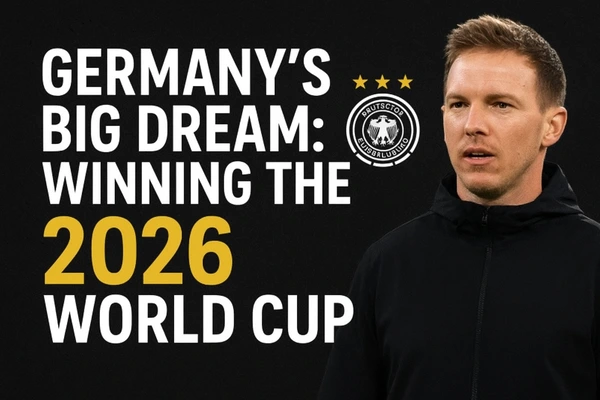
The four-time world champions will begin their road to the tournament on Thursday when they face Slovakia in Bratislava. After that, they’ll host Northern Ireland in Cologne on September 7. Germany is in Group A, which also includes Luxembourg, and many people believe they are the favorites to qualify. But Nagelsmann knows it won’t be easy—especially after their recent struggles.
Setting Big Goals
When reporters asked Nagelsmann if it was too ambitious to think about winning the World Cup, he gave a very interesting answer:
“It is healthy to set goals. It is difficult for a team or even an individual to go through life without a goal they are working towards, that is worth fighting for.”
In other words, he believes that every player, every coach, and every fan needs a dream to chase. And for Germany, that dream is lifting the trophy in North America in 2026, where the tournament will be co-hosted by the United States, Canada, and Mexico.
Nagelsmann added:
“I think it is healthy that we all want to win the World Cup. I am 100% convinced that no player would answer differently or they would not need to travel with us.”
That’s a bold statement, but it shows how confident he is in his team.
Germany’s Recent Struggles
Even though Germany has one of the richest histories in soccer—they’ve won the World Cup four times (1954, 1974, 1990, 2014)—the last few years have been tough.
In 2018, they were knocked out in the group stage in Russia.
In 2022, it happened again in Qatar, shocking fans around the world.
At Euro 2024, which Germany hosted, they played better but still got eliminated in the quarterfinals.
And to make matters worse, they’ve lost their last two games, against Portugal and France in the Nations League. For many German fans, this has been frustrating. Some polls even show that not everyone believes in Nagelsmann’s big dream.
But the coach says that’s okay. What matters most is not just the dream, but the process of getting there.
Focus on the Process
Nagelsmann explained it like this:
“We need to focus on the process until we get there, on every game. To not have moments of doubt because of the big goal. The process is decisive to reach goals.”
Basically, he’s telling the players: Don’t think too far ahead. Don’t only dream about holding the World Cup trophy. First, focus on each match—qualifying, playing with rhythm, and building confidence. If they can do that, the bigger dream will take care of itself.
Why Germany Still Believes
Even with recent failures, there are many reasons Germany could succeed in 2026.
Young Talents Rising – Players like Jamal Musiala, Florian Wirtz, and Kai Havertz are among the most exciting young stars in Europe. They give Germany speed, creativity, and fresh energy.
Strong Tradition – Germany is known for bouncing back. After disappointing tournaments, they often rebuild and return stronger. For example, after losing in the 2000 Euros group stage, they rebuilt their youth system, which helped them win the 2014 World Cup in Brazil.
Nagelsmann’s Leadership – At just 37 years old, Julian Nagelsmann is one of the youngest coaches in international soccer. He’s famous for his tactical mind, modern training methods, and ability to connect with players. Many experts believe his style fits perfectly with Germany’s new generation.
Clear Path in Group A – With Slovakia, Northern Ireland, and Luxembourg as opponents, Germany is expected to dominate and qualify comfortably. That gives them a chance to build rhythm and confidence before facing tougher challenges.
Soccer Facts Combo
To make things fun, let’s mix some soccer facts, news, and combos into Germany’s journey:
Soccer Fact #1: Germany is the second-most successful nation in World Cup history (4 titles), behind only Brazil (5 titles).
Soccer News Combo: Did you know? The 2026 World Cup will feature 48 teams instead of 32. That means more games and more chances for upsets. Teams like Canada and USA will also get to shine on home soil.
Soccer Fact #2: Julian Nagelsmann once became the youngest coach in Bundesliga history when he took charge of Hoffenheim at just 28 years old. Now, at 37, he’s leading Germany on the world stage.
Soccer News Combo: In their last meeting with Slovakia (Euro 2016), Germany won 3-0 in the round of 16. That’s a good memory to take into Thursday’s qualifier.
Soccer Fact #3: Germany has scored more goals in World Cup history (226) than any other country.
Soccer News Combo: But since 2018, their scoring form hasn’t been the same. That’s why stars like Musiala and Havertz will be key for bringing the goals back.
What’s Next for Germany
Germany’s road begins with Slovakia on September 4. This is a chance to show improvement after back-to-back losses. Then, on September 7, they play Northern Ireland in Cologne, where fans will expect a strong home win.
Nagelsmann said it clearly:
“The most important thing is to win matches and qualify and we hope to do it with dominance.”
Winning with dominance means not just scraping by but playing with confidence, controlling games, and scoring goals. That’s what Germany fans want to see again.
Final Thoughts
Germany’s dream of winning the 2026 World Cup may sound ambitious, especially after their recent struggles. But soccer is full of stories about teams that bounced back after tough times.
Remember: Spain was eliminated in the group stage in 2014, just four years after winning the World Cup. France didn’t even qualify for the 1994 tournament but became world champions in 1998. Comebacks happen all the time in soccer.
For Germany, the combination of talented young stars, a bold young coach, and a strong soccer tradition could be exactly what they need. Fans may still be doubtful, but if Nagelsmann’s plan works, Germany might surprise everyone in 2026.
Until then, every match, every goal, and every qualifier counts. The dream is alive—and Germany is ready to chase it.