



Football doesn’t stand still.
Every few years, something shifts—tactically, physically, or structurally. Systems evolve, player roles change, and what once worked at the highest level slowly becomes outdated.
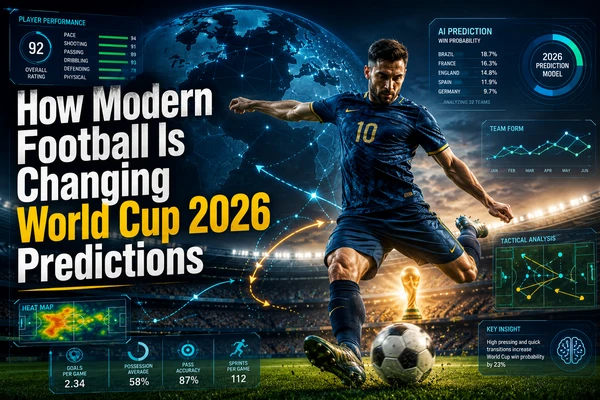
By the time a World Cup arrives, the game often looks slightly different from the one we remember.
That’s exactly what’s happening ahead of 2026.
And if you’re trying to build accurate World Cup 2026 predictions, understanding how modern football is evolving is no longer optional—it’s essential.
The Game Is Faster Than Ever
The most noticeable change in modern football is speed.
Not just in terms of sprinting, but in decision-making, transitions, and ball movement. Matches are played at a higher tempo, with less time on the ball and greater emphasis on quick reactions.
Teams like the France national football team have mastered this balance—combining physical intensity with technical precision.
In a World Cup setting, where matches can be decided by small margins, that speed becomes a major advantage.
Pressing Has Become Standard
High pressing was once considered a specialized tactic. Now, it’s part of the default approach for many top teams.
Instead of waiting for opponents to make mistakes, teams actively force them.
The England national football team and the Netherlands national football team have both integrated pressing into their systems, using it to control matches without necessarily dominating possession.
This trend changes how games unfold—mistakes happen earlier, transitions are quicker, and defensive organization becomes even more important.
Positional Flexibility Is Redefining Roles
Traditional positions are becoming less rigid.
Full-backs move into midfield. Wingers drift centrally. Midfielders drop deeper or push higher depending on the situation.
The Brazil national football team, for example, often relies on fluid attacking structures where players interchange positions constantly.
This flexibility makes teams harder to predict—and harder to defend against.
For analysts and fans, it also makes predictions more complex.
Squad Rotation Is Now Tactical, Not Optional
Modern football isn’t just about starting lineups—it’s about managing an entire squad.
With increased physical demands and tighter schedules, rotation has become part of the tactical plan rather than a backup option.
Teams that rotate effectively maintain intensity across multiple matches. Those that don’t risk fatigue and inconsistency.
This is especially relevant for a tournament like 2026, where the expanded format places even greater emphasis on endurance.
Data and Tactics Are Now Interconnected
Tactical decisions are increasingly supported by data.
Coaches analyze patterns in real time, adjust formations based on metrics, and use detailed insights to prepare for opponents.
This combination of analytics and tactics allows teams to refine their approach with precision.
It also means that traditional assumptions—based on reputation or past success—are less reliable.
Defensive Structures Are More Complex
Defending is no longer just about staying organized—it’s about adapting.
Teams shift between defensive shapes depending on the phase of play. They press high, drop deep, and transition quickly between systems.
The Argentina national football team demonstrated this adaptability during FIFA World Cup 2022, adjusting their approach depending on the opponent.
In 2026, this kind of flexibility will likely be even more important.
The Rise of Hybrid Players
Modern squads are built around versatility.
Players are expected to perform multiple roles, adapt to different systems, and contribute both offensively and defensively.
This trend increases tactical options—but also raises expectations.
Teams with more adaptable players can respond more effectively to different match situations.
What This Means for Predictions
All of these trends point to one conclusion: the game is becoming more complex.
It’s no longer enough to evaluate teams based on talent alone. You need to consider how they play, how they adapt, and how they manage different phases of the game.
This complexity makes World Cup 2026 predictions more challenging—but also more interesting.
A Broader Tactical Perspective
Understanding modern football trends provides a deeper context for analyzing teams and matches.
If you want to explore how these tactical developments translate into real tournament scenarios—including team performance and match outcomes—you can check out
football predictions World Cup
for a more complete view.
Final Thoughts
The World Cup has always reflected the state of football at a given moment.
In 2026, that moment will be defined by speed, flexibility, and complexity.
Teams that adapt to these trends will have an advantage. Those that rely on outdated approaches may struggle.
Because in modern football, evolution isn’t gradual.
It’s constant.